Ravensbrück
The Glass RoomRavensbrück is the women’s concentration camp where Hana Hanáková was imprisoned, gave birth to her daughter Světla, and lost her when the child was taken away. Though Hana survives, the camp’s lasting presence in the novel is carried by what she has never told: a secret that makes her survival inseparable from the hope of seeing her daughter again and transforms the Landauer House’s Glass Room into a place of painful historical witness.
Place in Hana’s Story
Hana first speaks of Ravensbrück to Zdenka Vondráková in a café, explaining that she survived through luck and love. She recalls finding love even amid fear and squalor, then asks Zdenka to dance for her in the Glass Room, as if beauty might be recovered there. The revelation is both a disclosure of the camp’s place in Hana’s life and a request to keep beauty present alongside the memory of what happened.
The fuller account comes later, when Hana tells Zdenka that she had a baby in the camp. She says she had believed herself barren, having wanted a child without conceiving with her husband or other men. The child was fathered by a German scientist who wanted nothing to do with the pregnancy; Hana, by contrast, wanted the baby. Her account connects the camp to an earlier life shaped by gendered vulnerability and to a motherhood she had not expected to experience.
Imprisonment and Birth
Hana recounts being arrested and taken first to a place in Austria near Linz. From there, she and many others were crowded into cattle trucks and transported across Germany. She did not know their destination at the time. What she remembers is arriving in a wilderness of barbed wire and rows of huts, where women in her hut looked after one another. Amid the chaos, women cared for other women and gave birth.
Hana’s daughter was a little girl with dark hair and a wrinkled face that reminded her of an old woman. The baby’s cry was short and sharp, as if she were gasping for air. Hana named her Světla, meaning light in the darkness, and loved her. The name holds together the camp’s darkness and the brief, fiercely cherished life that Hana found within it.
Separation and Survival
The baby was put to Hana’s breast and tried to feed, but Hana had no milk. The child was then taken away, and Hana never saw her again. Hana contrasts this with a later arrangement in which mothers could keep their babies in a maternity hut for as long as the children survived. When Světla was born, she says, babies were simply taken from their mothers.
Hana imagined that her daughter might survive and that they would be reunited after the war. The possibility remained a fantasy, but it gave Hana a reason to survive: had she died, she could not have reached the imagined reunion. She therefore understands Světla as having saved her life, even though they never met again. The loss does not resolve into consolation; Hana weeps as she tells it.
The Camp as Recovered History
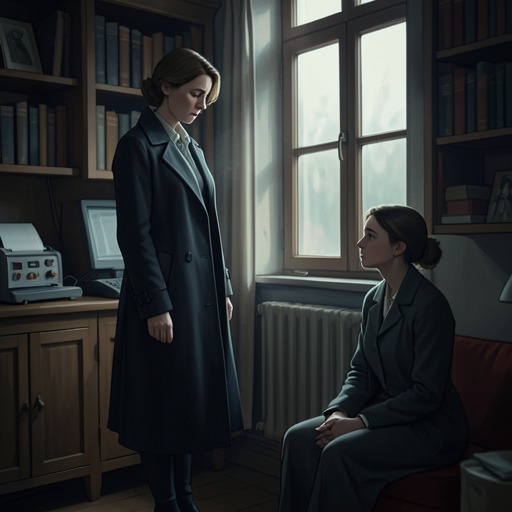
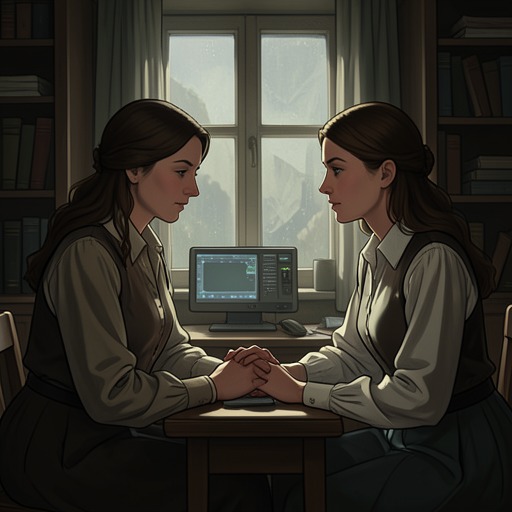
Hana says she has never told anyone about the baby before. Zdenka, who had expected their conversation to return to Hana’s love for her, instead receives this account of birth, separation, and survival. Her shock and inability to find comforting words make her a witness rather than an interpreter; at last, she crosses the room and embraces Hana.
The disclosure also alters the meaning of the Glass Room. A space associated with openness and transparency becomes the setting for a secret carried for years, while its glass, concrete, chrome, onyx, tropical hardwood, and pale ceiling lights seem to hold the past around the two women. The narrative places Hana’s embodied memory against Tomáš’s denial of history: Ravensbrück is not an abstraction or a vanished episode but a history that remains present in Hana’s face, grief, and testimony.